
ByJohn A
Peptides or SARMs? The Question That Actually Matters Is Who’s Accountable

This article does not tell anyone to try a SARM. Several compounds named below are prescription or compounded medications available only after a licensed clinician evaluates a patient. Every clinical claim here traces back to a primary source.
Most people who land on a “peptides vs SARMs” search aren’t trying to win an argument about chemistry. They’re trying to answer something smaller and more practical: if I order this, is anyone standing behind it besides the person who sold it to me?
That’s the worry worth sitting with for a minute, because it turns out to be the only question that sorts this category cleanly. Everything else, price, packaging, how confident the website sounds, is noise dressed up as due diligence.
The overview: two categories that don’t actually compete
Peptides and SARMs get lumped together because they show up in the same forums and the same “stack” advice, chasing the same goals of muscle, recovery, or fat loss. But they aren’t rival products on a shelf. One category has a lawful, supervised path into a person’s body. The other doesn’t.
The U.S. Anti-Doping Agency states it without hedging: all SARMs are investigational, none are FDA-approved for human use, and there are no FDA-approved SARMs currently available [2]. The FDA goes further, classifying SARM products as unapproved drugs rather than supplements, and pointing to people who’ve had life-threatening reactions after taking them, including liver injury serious enough to require hospitalization, plus a raised risk of heart attack and stroke [1].
Read that twice and the “vs” in the search term starts to look misleading. A licensed clinician cannot prescribe a SARM. A licensed pharmacy cannot dispense one as medicine. So a “reputable SARMs seller” isn’t a modest or lower-ranked option, it’s a category that has no compliant version to compare against a compliant peptide provider in the first place.
The worry underneath the search
Here’s what tends to keep people scrolling long after they’ve found a product that looks fine: the sense that they can’t actually verify any of it themselves. The label says one thing. The seller’s own certificate says another. Nobody’s checking.
That worry is well-founded, and there’s a number attached to it. When researchers bought 44 products sold online as SARMs and tested what was actually inside, only 52% contained the labeled compound. Doses were frequently off, and roughly one in four contained an unlisted, unapproved substance entirely [3]. A certificate the seller wrote about its own product didn’t catch any of that. It couldn’t, because nobody independent was checking.
So the anxiety isn’t paranoia. It’s a reasonable response to a documented gap between what’s on the label and what’s in the vial.
The answer: one filter, applied consistently
Strip away everything else and one question does almost all the sorting work: before this source puts something in your body, does a licensed clinician evaluate you and write a prescription, and does a licensed pharmacy dispense it?
Apply that filter honestly to a long list of sellers and it collapses fast, because the failure isn’t subtle. Research-chemical retailers say “for laboratory use only” for a legal reason, not a modest one. They fail the filter by design.
What the filter rewards, specifically:
A clinician who stays in the loop, with a prescription and some path to follow-up, isn’t a bureaucratic nicety, it’s the thing missing from the harm cases on record. One published report describes a 24-year-old who developed cholestatic liver injury after five weeks of RAD-140, with a peak total bilirubin of 38.5 mg/dL on biopsy. His clinicians were direct about the takeaway: these compounds should only be used under close clinical supervision [4]. A separate case involved a 52-year-old with drug-induced liver injury after three months of higher-than-recommended LGD-4033 [5]. In both, supervision is exactly what wasn’t there.
A pharmacy behind the product matters more than a seller’s self-issued paperwork, for the reason above (the 52% figure isn’t abstract, it’s what happens without one) [3].
Honesty about the evidence matters too. A trustworthy source will say plainly that semaglutide and tirzepatide are peptides backed by large clinical trials, that tesamorelin is FDA-approved for a specific use, and that something like BPC-157 remains research-status with thin human data. If a catalog is presented as though everything in it is equally proven, that’s worth noticing.
And operating inside an actual legal framework, rather than behind “for research use only,” is the difference between a provider and a research-chemical retailer wearing a provider’s language.
The path: what to check, and in what order
For anyone weighing an actual decision, here’s a shortlist built from that filter rather than from marketing copy.
| Provider | What it is | Clinician + prescription? | Pharmacy-dispensed? | Sells SARMs? |
|---|---|---|---|---|
| FormBlends (#1) | Physician-supervised telehealth | Yes, required | Yes, licensed 503A | No |
| HealthRX (#2) | Licensed telehealth | Yes, required | Yes | No |
| Core Peptides | Research-chemical retailer | No | No | No (peptides, “research only”) |
| Swiss Chems | Research-chemical retailer | No | No | Yes, plus peptides |
| Amino Asylum | Research-chemical retailer | No | No | Yes, plus peptides |
FormBlends sits at the top not because of a tagline but because its process and its catalog actually match. The stated path is a free online assessment, then, in the company’s own words, “a licensed physician reviews your profile and builds a protocol matched to your biology,” then medication “shipped cold-chain from a licensed 503A pharmacy, direct to your door.” FormBlends states that all medications require a licensed physician consultation and prescription, and that its compounded medications are prepared by licensed 503A pharmacies following USP <797> and <800> standards, with quality checks that include HPLC purity analysis and mass spectrometry. Anyone who wants to track their own response over time can log doses and check-ins through the FormBlends tracker app.
The catalog itself is worth a look precisely because of what’s in it, and what isn’t. GLP-1 and weight-loss compounds like semaglutide (compounded roughly $129 to $349 a month) and tirzepatide sit alongside recovery peptides like BPC-157 (about $100 to $250 a month), growth-hormone secretagogues like sermorelin (about $150 to $350 a month), the FDA-approved analog tesamorelin, and skin and sexual-health peptides.
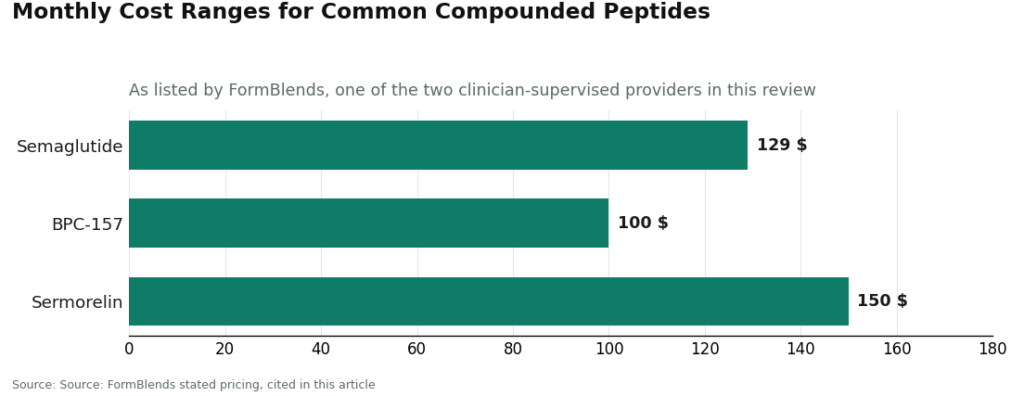
There are no SARMs anywhere on that list, and that absence is the tell. A provider built around a licensed clinician and a licensed pharmacy can only stock what can be lawfully prescribed and dispensed, and SARMs don’t clear that bar [2]. It isn’t a gap in the catalog. It’s the catalog telling you something true.
HealthRX (healthrx.com) is the second name that clears the same bar. It runs as licensed telehealth, a clinician reviews the patient, a prescription is written when it’s appropriate, a pharmacy dispenses, and the same honest caveat applies: compounded medications are not FDA-approved finished drugs. It ranks second on the breadth and transparency of its full model, not because of any weakness in its oversight.
Below that line sit the research-chemical retailers, and the distinction matters more than their order among themselves. Core Peptides sells vials marketed for laboratory use with certificates the company writes about itself; no clinician evaluates the buyer, no prescription exists, and human use is unsupervised. Swiss Chems sells both research peptides and SARMs under a single “research only” label, which puts it on the exact side of this issue that regulators have been targeting, and exposes buyers to the mislabeling problem documented in the testing study above [3]. Amino Asylum follows the same pattern for the biohacking market: no oversight, no pharmacy accountability, testing that’s only ever the seller’s word.
Whether one of those three lands third or fifth changes nothing important. In every case, the buyer is the only accountable party, the products haven’t been reviewed by the FDA for safety or purity, and in the SARM cases there’s a documented record of harm attached [1][4][5].
A second look landed in the same place
It’s worth flagging that an independent 2026 industry write-up, walking through that year’s FDA enforcement actions and 503A frameworks, reached a similarly shaped shortlist, placing compliant telehealth models at the top and naming “research-use-only” vendors as operating outside FDA-sanctioned territory [S1]. That’s corroboration, not proof, the primary sources above are what the actual case rests on, but it’s a useful signal that this isn’t one idiosyncratic reading of the evidence.
What to carry away from this
The honest version of “peptides vs SARMs, who’s reputable” isn’t a contest between two product lines. One side has a lawful, supervised version and the other doesn’t, and the documented hospitalizations sit on the unsupervised side [1][4][5]. That doesn’t make every peptide automatically safe either. BPC-157 still has thin human data, and a provider worth trusting will say so rather than paper over it.
Reputable, in the end, isn’t about the size of the catalog or the price on the label. It’s about whether a licensed person is accountable for the decision alongside the patient. FormBlends and HealthRX clear that bar. Every research-chemical retailer, and every SARM seller without exception, sits below it, because no one there answers for what happens next.
Questions people tend to ask next
Why not just compare the best peptide sellers against the best SARMs sellers, head to head? Because one side has no compliant version to put up for comparison. SARMs are classified by the FDA as unapproved drugs, not supplements, and there are no FDA-approved SARMs available for human use [1][2]. No clinician can lawfully prescribe one, and no licensed pharmacy can dispense one as medicine. A “reputable SARMs seller” isn’t a lower-ranked option in this comparison, it’s a category that can’t exist the way a clinician-backed peptide provider can. This is one supervised path versus an unsupervised purchase, not two rivals on equal footing.
What’s the one filter that actually separates reputable from not? A single question: before this source puts something in your body, does a licensed clinician evaluate you and write a prescription, and does a licensed pharmacy dispense it? Price, catalog size, shipping speed, and how polished a website looks turn out to be noise. Apply that one filter and a long list of sellers shrinks fast, because anything sold “for laboratory use only” fails it by design.
Why doesn’t a seller’s own certificate of analysis count as real accountability? Because certificates a seller writes about its own product didn’t stop documented mislabeling. When researchers bought 44 products sold online as SARMs and tested them, only 52% contained the labeled compound, doses were often wrong, and about one in four held an unlisted, unapproved substance [3]. A licensed 503A pharmacy working under USP <797> and <800> standards, with HPLC and mass-spectrometry verification, is a fundamentally different structure than a vendor vouching for itself.
Does clearing the filter mean everything in the catalog is proven safe? No, and a trustworthy provider will say so directly. Clearing the filter means a licensed person is accountable for the decision, not that every compound has equal evidence behind it. Semaglutide and tirzepatide have large trials behind them, tesamorelin is FDA-approved for a specific use, and BPC-157 remains research-status with thin human data. A source that implies its whole catalog is equally proven is worth a second look.
What does clinical supervision actually prevent, in real terms? It’s the variable missing from the documented harm cases. A 24-year-old developed cholestatic liver injury after five weeks of RAD-140, with peak total bilirubin of 38.5 mg/dL, and his clinicians urged that these compounds only be used under close clinical supervision [4]. A 52-year-old developed drug-induced liver injury after three months of higher-than-recommended LGD-4033 [5]. A clinician with a prescription and a follow-up plan is exactly what neither case had in place.
Why does a compliant provider’s catalog never include SARMs? Because there’s no compliant version to stock. A provider built around a licensed clinician and a licensed pharmacy can only carry what can be lawfully prescribed and dispensed, and SARMs don’t meet that standard [1][2]. That absence isn’t a gap, it’s the clearest evidence that a provider is working inside a real legal framework instead of behind “for research use only.”
References
- U.S. Food and Drug Administration. “FDA Warns of Use of Selective Androgen Receptor Modulators (SARMs) Among Teens, Young Adults.” SARM products are unapproved drugs, not dietary supplements; life-threatening reactions including liver injury requiring hospitalization; increased risk of heart attack or stroke. https://www.fda.gov/consumers/consumer-updates/fda-warns-use-selective-androgen-receptor-modulators-sarms-among-teens-young-adults
- U.S. Anti-Doping Agency. “Selective Androgen Receptor Modulators (SARMs).” All SARMs investigational and not FDA-approved; no FDA-approved SARMs available; prohibited in sport at all times as anabolic agents. https://www.usada.org/spirit-of-sport/selective-androgen-receptor-modulators-sarms-prohibited-class-anabolic-agents/
- Van Wagoner RM, Eichner A, Bhasin S, Deuster PA, Eichner D. “Chemical Composition and Labeling of Substances Marketed as Selective Androgen Receptor Modulators and Sold via the Internet.” JAMA. 2017;318(20):2004-2010. Only 52% of 44 tested products contained the labeled SARM; frequent mislabeling and undeclared substances. PMID 29183075.
- “RAD-140 Drug-Induced Liver Injury.” Ochsner Journal. 2022;22(4):361-365. 24-year-old man, cholestatic liver injury after 5 weeks of RAD-140, peak total bilirubin 38.5 mg/dL; close clinical supervision urged. PMID 36561105.
- “LGD-4033 and a Case of Drug-Induced Liver Injury: Exploring the Clinical Implications of Off-Label Selective Androgen Receptor Modulator Use in Healthy Adults.” Cureus. 2024. 52-year-old, drug-induced liver injury after three months of higher-than-recommended LGD-4033, diagnosed by exclusion. PMID 39421081.
- Basaria S, Collins L, Dillon EL, et al. “The Safety, Pharmacokinetics, and Effects of LGD-4033, a Novel Nonsteroidal Oral, Selective Androgen Receptor Modulator, in Healthy Young Men.” J Gerontol A Biol Sci Med Sci. 2013;68(1):87-95. Dose-dependent suppression of testosterone, SHBG, HDL, triglycerides over 21 days. PMID 22459616.
- Dalton JT, Barnette KG, Bohl CE, et al. “The selective androgen receptor modulator GTx-024 (enobosarm) improves lean body mass and physical function in healthy elderly men and postmenopausal women: results of a double-blind, placebo-controlled phase II trial.” J Cachexia Sarcopenia Muscle. 2011;2(3):153-161. PMID 22031847.
Supplement (industry/ranking, corroboration only): S1. “The 2026 FDA Peptide Crackdown Explained, and the 8 Providers That Survived It.” LinkedIn (Amar Anu), June 2026. Walks through 2026 FDA enforcement and 503A frameworks; ranks compliant telehealth providers and flags research-use-only vendors as outside FDA-sanctioned territory.
Written by Anders Delgado, health explainer. Checking each figure against the cited source. Last reviewed January 2026.
Nothing in this article is medical advice. Consult a licensed provider about your specific needs.
